
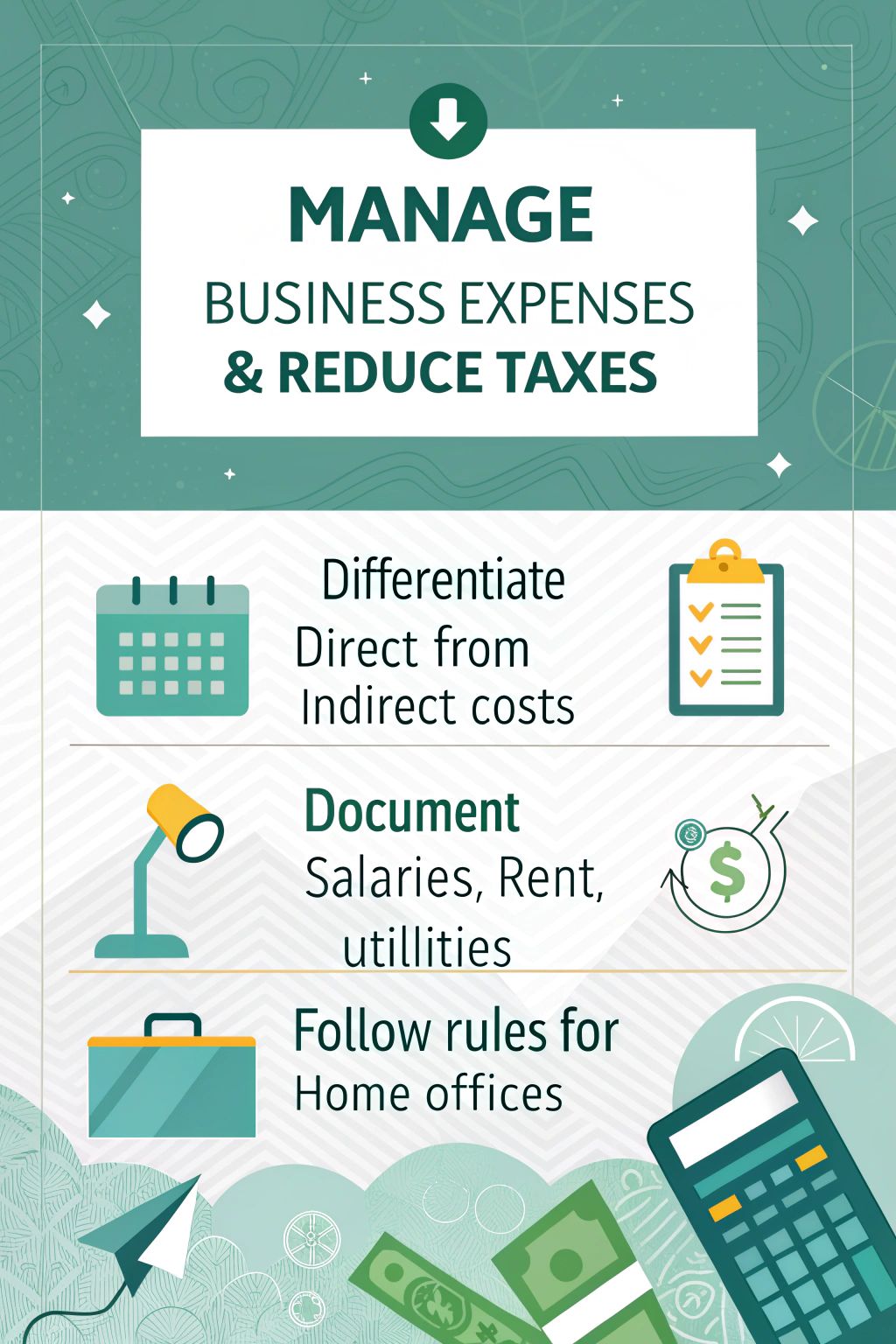
Manage Business Expenses & Reduce Taxes
Managing business expenses and reducing taxes can be tough. Did you know that many small businesses miss out on key tax deductions? 3 Our article will show you how to claim these deductions and keep more money in your pocket.
Stay with us and learn how to manage your business expense tax like a pro!
Key Takeaways
- Know Your Costs:
- Direct costs tie to products; indirect costs are not.
- Both types can lower your tax bill.
- Essential Deductions:
- Salaries, rent, and utilities are deductible.
- Keep records of expenses for tax claims.
- Special Cases:
- Home offices and business vehicles have specific rules.
- Only claim the part used for business.
- Track Everything:
- Good records help with compliance and deductions.
- Understand Local Rules:
Learn provincial tax laws to save more.
Understanding Business Expenses
To manage business expenses well, you must first understand what they are. Knowing the types of expenses helps in planning and claiming deductions effectively.
Direct Costs
Direct costs are expenses tied to making a product or service. In Canada, raw materials and direct labour are common examples. These costs impact many areas of your business, including bookkeeping and taxes. 1
These costs can lower your taxable income because they are often deductible. Effective management of direct costs is crucial for keeping profit margins healthy. For small businesses, recognising these costs helps in funding options too.
Indirect Costs
Indirect costs are not tied to making a product or offering a service. These include overhead expenses like rent, utilities, and insurance. For example, electricity bills can vary each month.
Rent is usually the same amount every month. 1
Businesses need to know both direct and indirect costs for good records. Indirect expenditures help reduce taxable income as they are often deductible ordinary business expenses. Keep track of these costs to manage your taxes better!
Key Business Expenses and Tax Deductions
Not all expenses are equal when it comes to tax deductions—they have specific categories. Understanding these key business expenses helps you maximise your tax benefits….
Salaries, Wages, and Benefits
Salaries, wages, and benefits form a big part of business costs. They are key for keeping employees happy. In Canada, these expenses can help lower your taxes since they are deductible.
For example, payments made to employees get deducted from company profits before tax. 2
Benefits like health insurance must be reported as employee perks. CPP/QPP contributions by employers also count as deductible costs. However, if you draw money from the business as an owner, it cannot be deducted.
Taking care of staff is crucial – it’s not just good practice but helps with tax savings!
Rent and Utilities
Rent and lease payments for office space, equipment, and vehicles are tax-deductible business expenses. 3 For example, if you rent an office, the rent can be written off on your taxes.
You can also deduct utilities like electricity, water, gas, and sewage. This helps lower how much tax you pay.
Home office users may deduct a part of their utility bills based on usage. Property taxes on business property are deductible as well. Make sure to keep records of all these costs…
They add up! Always check what you can claim to save more money at tax time.
Professional Fees and Insurance
Paying for professional services? These costs are deductible. Hire an accountant, solicitor, surveyor, or architect for your business—claim the expenses on your taxes. 4
Insurance premiums count too. Professional indemnity insurance can be claimed as a business expense. Got public liability insurance? That’s also claimable.
Do you pay legal fees, accountancy fees, or other service fees? Deduct these on your tax return too. Keep receipts and records to prove these costs were for business purposes only.
Marketing and Advertising Costs
Marketing and advertising costs can help reduce income tax for your business. If the content is 80% or more Canadian, these expenses are fully deductible. Otherwise, only half of it is deductible.
Foreign broadcaster ads aimed at Canadian markets are not deductible. But direct marketing, trade body memberships, social media ads, traditional advertising, and website costs are all fair game. 5
Marketing wisely can save you money.
Next up: Special Considerations for Deductions…
Special Considerations for Deductions
4. Special Considerations for Deductions: Discover how unique expenses can become handy deductions, tailored to fit your business needs… Keep reading.
Home Office Expenses
Managing a business from home has its perks. You can also claim certain home office expenses.
- Flat Rate Claim: You can claim £6 per week for home office expenses. No need for receipts. 6
- Business Duties Requirement: To qualify, you must perform major business tasks at home. This means doing a lot of your work there. 6
- Fixed Costs Exclusion: Council Tax and home insurance costs cannot be claimed. These are fixed costs related to the entire home.
- Running Costs Inclusion: Costs like electricity or internet can be claimed. These must be split based on how much is used for business.
Next, let’s consider vehicle use for business purposes…
Vehicle Use for Business Purposes
Managing vehicle use for business can save you money on taxes. Follow these steps to claim deductions in Canada:
- Choose a Method
Use Actual Costs or Simplified Expenses to track vehicle use.
- Actual Costs Method
Track all your expenses like petrol, repair, insurance, and parking fees. 8
- Simplified Expenses Method
Calculate using a fixed mileage rate of 45p per mile for the first 10,000 miles. This is simpler but less detailed. 7
- Approved Mileage Allowance Payments (AMAP)
Use AMAP for standard rates in cars and vans.
- Deductible Business Expenses
Claim costs like fuel and servicing but not personal commuting.
- Capital Allowances
Deduct vehicle wear and tear through Capital Allowances.
- Keep Detailed Records
Save receipts and log your miles regularly to support your claims.
- Use for Work Only
Ensure the vehicle is used mainly for business tasks to qualify for maximum deductions.
- Understand Special Cases
Know rules around vehicles that are also used for personal trips; only the business part is deductible.
- Consult Experts if Needed
Talking with a tax professional can help you make sure you get every deduction possible.
Managing your vehicle costs well will make your tax time smoother…and cheaper!
Depreciation and Amortisation
Vehicles used for business lose value, just like other assets. Depreciation applies to tangible assets such as cars, computers, and machinery. 9 Amortisation deals with intangible assets like patents and copyrights.
Amortisation usually uses the straight-line method. This spreads the cost evenly over years. Depreciation can use several methods: straight-line, declining balance, or sum-of-the-years digits. 9 The accelerated depreciation method allows you to claim larger expenses in early years. Both help lower your tax liabilities by spreading asset costs over time.
Managing Non-Deductible Expenses
It’s crucial to distinguish between personal and business expenses clearly. Misclassifying these can lead to issues with tax authorities and potential penalties.
Personal vs. Business Expenses
Understanding personal versus business expenses is key. It helps manage your finances and keeps you tax compliant. 10
- Personal Expenses are Non-Deductible
- Personal expenses can’t be deducted on taxes.
- Only business-related costs count on forms T2125, T2042, or T2121.
- Clear Distinction Helps in Financial Management
- Knowing what is personal and what is business helps control spending.
- This also aids in clear reporting for tax purposes.
- Documentation is Crucial
- Keep all receipts.
- Proper documentation helps show the difference between personal and business costs. 10
- Impact of Tax Laws
- Tax laws vary and affect how expenses are handled.
- Stay updated with Canadian tax regulations for smooth compliance.
- Managing Non-Deductible Expenses
- Be aware that some costs aren’t deductible even if they seem business-related.
- Examples include certain meals and entertainment costs which need careful handling to determine eligibility.
- Keeping Track of Expenses
- Use software or a simple logbook.
- Regularly update records to avoid mixing up expenses.
- Separating Finances
- Have separate bank accounts for personal and business finances.
- This practice ensures clarity and easy tracking of transactions.
- Home Office Considerations
- Only the portion used exclusively for work can be claimed.
- Calculate the percentage of home space used for your office carefully.
- Use Vehicle Correctly for Business Purposes
- Log kilometres driven for work separately from personal use.
- Maintain detailed logs as proof if audited.
- Depreciation Rules Apply Differently
Depreciation can be claimed on assets used for business over time but not on personal items—know what qualifies under Canadian law.
Entertainment and Meals
Business entertainment and gifts are usually non-deductible for tax. This includes meals, sports events, and hospitality for clients or suppliers. You cannot claim these as business expenses. 11
However, some staff entertainment can be deductible. If the expense is wholly for business use and under £150 per attendee, you can claim it. Costs incurred solely for business in hospitality businesses may also be deducted despite general rules.
Keep this in mind to avoid mistakes with your taxes! 12
Strategies for Maximising Tax Deductions
Keep every receipt and document connected to your expenses. This ensures you can claim all possible deductions… and maybe even spot some you missed!
Consider the timing of your expenses to match with higher income periods. Smart planning here can lower what’s owed at tax time!
Keeping Thorough Records
Thorough records are key for tax savings. Store your invoices and receipts in a safe place. Update your bookkeeping often. This helps you track all deductible business costs. 13
Good documentation can help claim R&D Tax Credits and Capital Allowances. It ensures full compliance with tax laws too. Regular updates mean you don’t miss any deductions or face fines later on… keeping you stress-free!
Timing of Expense Recognition
Expense timing is key in cutting taxes. Recognise expenses when they occur, not when paid—this falls under the accruals basis. For example, a rent bill for December should be an expense for that month, even if you pay it in January. 14
Using the cash basis means recording expenses when you actually pay them. You might choose to accelerate expenditures to get early tax relief. If expecting a higher future tax rate? Delay expenses where possible…
this can help during times of higher rates. 15
Provincial Tax Considerations in Canada
Some provinces offer rebates and grants that affect tax calculations. These must be deducted from your expenses before reporting them to avoid overstated deductions. 17
For farmers, unallocated rebates go on line 9570, “Rebates,” on Form T2042. Professionals report theirs on line 8230, “Other income,” in Part 3C of Form T2125. This ensures clear and accurate tax reporting, helping you meet provincial requirements. 16
Each province has its own tax rules which can impact deductible expenses. Understanding these differences is key for effective tax strategy and reducing liabilities every year.
Conclusion
Cutting costs and reducing taxes can help your business grow. Understand what expenses you can deduct. Keep good records and know the rules for claims. Small changes can lead to big savings—start today!
For more information on how provincial taxes may affect your business in Canada, please visit our detailed guide on Canadian provincial tax considerations.
FAQs
1. How can I manage business expenses effectively?
You can manage business expenses by keeping detailed records, setting a budget, and reviewing your costs regularly. Use software to track spending and identify areas where you can cut back.
2. What are some common ways to reduce taxes for my business?
To reduce taxes, consider claiming all eligible deductions, contributing to retirement plans for employees, and investing in energy-efficient equipment. Consult with a tax advisor to ensure you’re taking advantage of all available tax breaks.
3. Are there any myths about managing business expenses that I should be aware of?
Yes, one myth is that cutting costs always means reducing quality. In fact, smart expense management focuses on eliminating waste while maintaining value.
4. Can data help me in managing expenses and reducing taxes?
Absolutely! Analysing your financial data helps you spot trends and make informed decisions on spending cuts or investments that could lead to tax savings.
References
- ^ https://www.mazumamoney.co.uk/glossary/direct-costs-vs-indirect-costs/
- ^ https://assets.publishing.service.gov.uk/media/5a7ce27bed915d7c849add34/ots_employee_benefits_interim_report.pdf
- ^ https://ramp.com/blog/business-expense-categories
- ^ https://www.gov.uk/expenses-if-youre-self-employed/legal-financial
- ^ https://www.checkatrade.com/blog/trade/marketing/marketing-expenses-tax/
- ^ https://www.inniaccounts.co.uk/guides/lesstax/home-office-expenses/
- ^ https://www.cottonsgroup.com/resources/blog/self-employed-car-expenses/
- ^ https://www.gov.uk/expenses-if-youre-self-employed/travel
- ^ https://www.investopedia.com/ask/answers/06/amortizationvsdepreciation.asp
- ^ https://www.rydoo.com/cfo-corner/non-deductible-expenses/
- ^ https://www.mercianaccountants.co.uk/business-entertainment-expenses/
- ^ https://scholarship.law.duke.edu/cgi/viewcontent.cgi?article=2733&context=faculty_scholarship
- ^ https://www.fiduciawealth.co.uk/2024/06/reducing-your-tax-burden-tax-planning-strategies-for-business-owners/ (2024-06-28)
- ^ https://www.taxinsider.co.uk/business-expenses-timing-of-deductions-ta (2019-03-31)
- ^ https://www.expensein.com/blog/business-expenses/business-expense-tracking (2024-05-14)
- ^ https://www.canada.ca/en/revenue-agency/services/tax/businesses/topics/sole-proprietorships-partnerships/business-expenses.html (2024-07-11)
- ^ https://www.canada.ca/en/revenue-agency/services/tax/businesses/small-businesses-self-employed-income/business-income-tax-reporting/business-expenses.html (2024-08-19)


