
Minimize Capital Gains Tax in Canada
Paying capital gains tax can be a big worry for many Canadians. Did you know the new rules on capital gains taxes start in June 2024? 3 This blog will show you easy ways to lower your taxes.
Keep reading!
Key Takeaways
- New rules start in June 2024. The inclusion rate for gains over $250,000 will rise to two-thirds.
- Registered accounts like RRSPs and TFSAs help lower capital gains tax.
- Use losses to offset gains. Carry losses forward or back to save on taxes.
- Claim the principal residence exemption when selling your main home.
- Gift ecologically sensitive land for a 0% capital gains tax and other benefits.
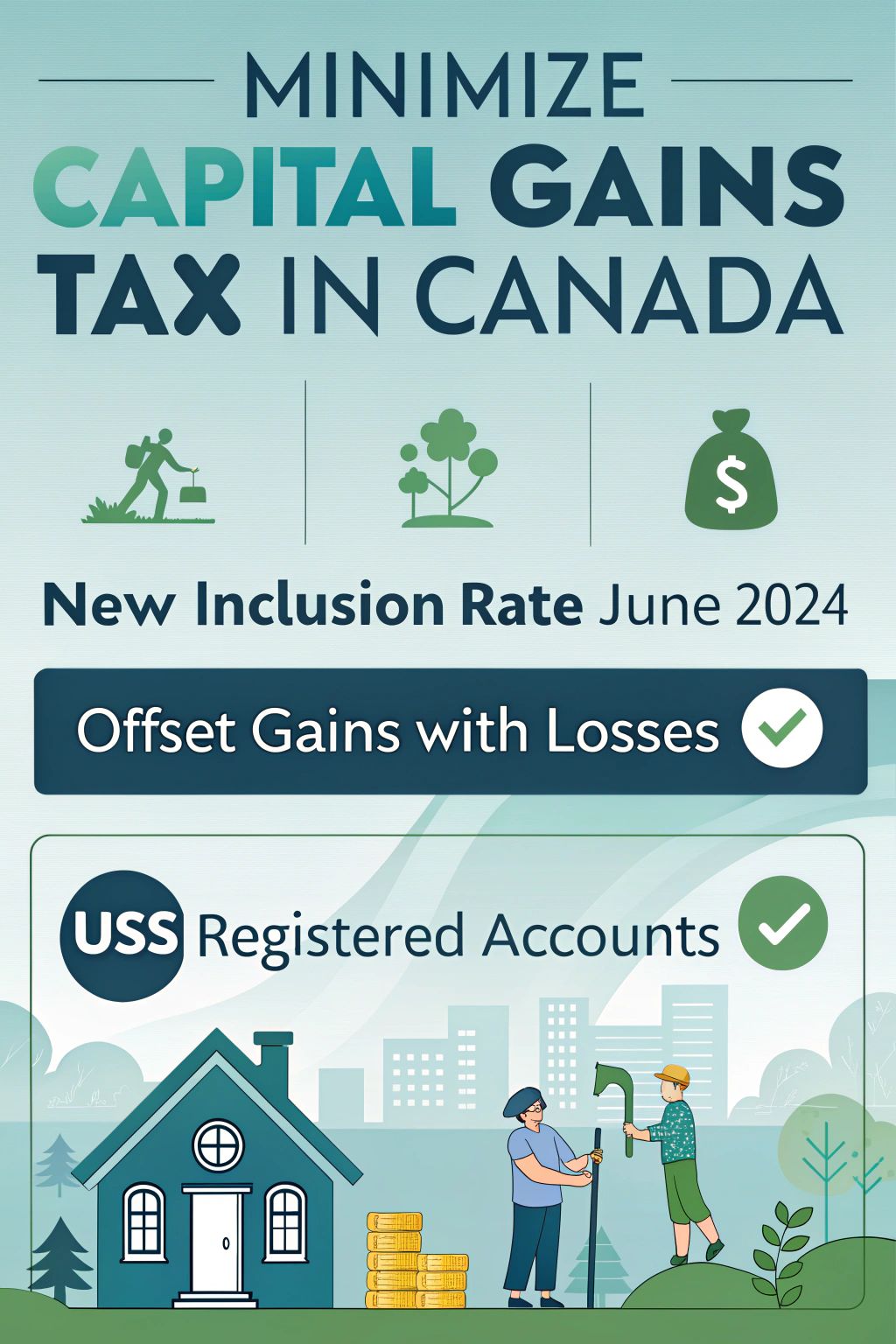
Understanding Capital Gains Tax in Canada
Capital Gains Tax in Canada applies when you sell an asset for more than what you paid. Understanding the tax rates and rules can help you make better decisions….
Definition of Capital Gains
Capital gains happen when you sell an asset for more than what you paid. For example, if you buy a stock for $100 and later sell it for $150, your capital gain is $50. This profit is called a “realised” gain once the sale happens.
Not all profits are taxable. The main home exemption means any capital gains from selling your primary residence are tax-free. Other items like jewellery or artwork might be taxable if they sell for over $1,000 in profit. 1
Current Capital Gains Tax Rates
Understanding how capital gains tax rates work in Canada is essential for effective tax planning. Here’s a summary of the current rates:
| Province/Territory | Max Tax Rate for Gains < $250,000 | Max Tax Rate for Gains > $250,000 |
|---|---|---|
| Saskatchewan | 23.8% | 23.8% |
| Newfoundland and Labrador | 27.4% | 36.5% |
| Other Provinces | Up to 27% | Varies |
Remember, no one pays more than 27% on gains under $250,000. 2 For higher earners, rates can rise considerably… up to 36.5% in some places.
It’s important to stay informed. Rates can change, and planning can save significant money.
Inclusion Rate for Capital Gains Tax
For capital gains tax, the inclusion rate is key. It tells how much of your gain you must report as income. Starting on 25 June 2024, this rate changes. If you are a corporation or trust, the rate will increase to two-thirds for all capital gains. 3
For individuals with gains over $250,000, the same rule applies: two-thirds will be included in your income. For smaller gains under $250,000, the current 50% inclusion stays. The rates have moved between 50% and 75%, but they have been at 50% since 2000.
The new rates may impact how you handle investments. 3
### Key Changes to Capital Gains Tax in 2024
Key Changes to Capital Gains Tax in 2024
In 2024, Canada is introducing new laws that affect capital gains tax. These changes will impact how much tax you pay when selling investments or property….
Overview of the New Legislation
New legislation will change the way capital gains tax works in Canada. Starting 25 June 2024, if your annual gains exceed $250,000, you will need to include 66.67% of these gains for tax purposes. 4
The federal budget also aims to help middle-class entrepreneurs. It increases the Lifetime Capital Gains Exemption. This means some business owners can protect more of their earnings from being taxed.
Implications for Individual Investors and Businesses
High-net-worth individuals and those selling valuable assets, like vacation homes, will feel the new tax rates. The principal residence exemption stays untouched—your main home’s capital gains stay tax-free.
Businesses should revise their investment strategies before 2024. Companies need to plan carefully. Accelerating asset sales can help minimise taxes… Before the new rates come in! Strategic planning is crucial now more than ever. 5
The best time to make changes is before new laws go into effect.
Strategies to Minimise Capital Gains Tax
Learn ways to keep more of your money by reducing capital gains tax. Use these smart strategies to make your investments work harder for you….
Utilising Registered Accounts for Investments
Utilising Registered Accounts for Investments can help lower your capital gains tax in Canada. Here are some effective strategies:
- Registered Retirement Savings Plan (RRSP)
- Contribution limits based on 18% of last year’s income.
- Lowers taxable income with contributions.
- Tax applies when you withdraw, often at a lower rate. 6
- Tax-Free Savings Account (TFSA)
- Withdrawals are tax-free.
- No tax on dividends or interest earned inside the account.
- Annual contribution room is $6,000.
- Registered Education Savings Plan (RESP)
- Suitable for saving for children’s education.
- Government grants up to $7,200 per child.
- Investments grow tax-free until withdrawal.
- First-Time Home Buyer Savings Account (FHSA)
- Helps first-time buyers save for a home.
- Contributions and withdrawals are tax-free if used for a home purchase.
- Dividend Income in Registered Accounts
- Dividends earned in RRSPs and TFSAs are free from tax.
- Maximises returns without an increase in taxable income.
- Compound Interest Benefits
- Compound interest grows faster without taxes eating into gains.
- Ideal for long-term savings goals.
- Tax-Efficient Investing
- Use registered accounts to invest in high-growth assets.
- Minimises immediate tax hits on large gains.
- Contribution Room Management
- Keep track of your available room to maximise benefits.
- Over-contributions can lead to penalties, so plan carefully.
- Financial Planning Strategies
- Work with financial advisors to optimise use of registered accounts.
- Align investments with personal financial goals and timelines.
These tips can help you make the most of registered accounts while minimising capital gains tax… Happy investing!
Balancing Capital Gains with Capital Losses
Balancing capital gains with capital losses can help you save on taxes. Here’s how you can do it effectively:
- Track Your Investments
- Watch your investments closely.
- Note gains and losses as they happen.
- Match Gains and Losses
- Use losses to offset gains.
- This reduces your taxable income.
- Carry Forward Losses
- Keep unused losses for future years.
- You can use them when you have more gains.
- Claim Past Losses
- Apply losses to past three years’ gains.
- Get a refund if you’ve overpaid taxes.
- Use Different Asset Types
- Balance stocks with property sales.
- Diversify to manage risk and tax better.
- Tax Instalments Impact
- Significant gains affect quarterly tax payments.
- Plan ahead to avoid penalties. 7
- Monitor Investment Timing
- Sell assets at a strategic time.
- Align sales with periods of loss if possible.
- Understand Tax Rules
- Learn about allowable business investment loss (ABIL).
- Special rules apply here, which can be beneficial.
9.Professional Help
.A tax advisor provides guidance tailored to your needs.
.Helps maximise savings and avoid mistakes. 8
Following these steps will help you balance gains and losses…and save on taxes!
Optimising the Use of the Principal Residence Exemption
Claim your home as your principal residence to avoid capital gains tax. In Canada, you can only have one principal residence at a time. Make sure you and your family live in that home.
“Your primary residence is a goldmine for tax savings.”
You need to notify the CRA about which property is your principal home. This means filling out forms and keeping good records. You can’t claim this exemption for rental properties or vacation homes.
…
## Strategic Estate Planning to Manage Future Tax Liabilities
Strategic Estate Planning to Manage Future Tax Liabilities
Paragraph of Text:
Estate planning can reduce future tax liabilities. It helps keep more of your wealth for heirs.
- Create a Will
A will makes asset transfer easy. 43% of Canadians do not have a will, says Scotiabank.
- Use Registered Accounts
Registered Retirement Savings Plans (RRSPs) and Tax-Free Savings Accounts (TFSAs) can shelter your investments from taxes.
- Gift Assets Early
Give assets to children or grandchildren while you are alive. This can lower the capital gains that might arise later. 7
- Setup Trusts
Trusts can manage and protect assets over time. They may help in reducing tax liabilities as well.
- Claim Principal Residence Exemption
Your main home is usually exempt from capital gains tax when sold or transferred.
- Invest in Small Business Shares (QSBCS)
Gains from Qualified Small Business Corporation Shares may be exempt up to a certain amount under the Lifetime Capital Gains Exemption.
- Plan for Giving to Charity
Donating to charity can provide tax credits while also reducing taxable estate value.
- Consider Joint Ownership
Owning property jointly with right of survivorship ensures that the property directly transfers to the other owner without going through probate, saving on taxes and legal costs.
Strategic estate planning helps preserve wealth and reduces future tax burdens for your heirs.
Special Considerations for Different Types of Assets
Understand how different assets affect your capital gains tax. Each type has unique rules and strategies… explore them to maximise benefits and avoid pitfalls!
Real Estate and Depreciable Property
-Capital gains or losses from selling real estate or depreciable property must be reported in section 5 of Schedule 3. 10 Recapture of capital cost allowance (CCA) might need to be included in your income.
If you sell at a loss, you could claim a terminal loss.
Depreciable assets like buildings lose value over time. This depreciation can affect how much tax you owe when sold. It’s important to keep accurate records and receipts for these properties…
Next, let’s look at stocks, bonds, and crypto-assets….
Stocks, Bonds, and Crypto-assets
Investing in real estate can be profitable, but let’s move to another type of asset: stocks, bonds, and crypto-assets. These are popular with many Canadian investors.
Stocks represent ownership in a company. When the stock price goes up and you sell them, you make a capital gain. Bonds are loans to companies or governments that pay interest over time.
Crypto-assets like Bitcoin are digital currencies bought and sold online for profit. 11
For all these investments, keeping detailed records is key. This helps when reporting gains or losses on your tax return. Only half the gains from selling these assets are taxable in Canada…so it pays to know your numbers!
Qualified Small Business Corporation Shares (QSBCS)
After considering stocks, bonds, and crypto-assets… let’s turn to Qualified Small Business Corporation Shares (QSBCS). QSBCS are shares in a Canadian-controlled private corporation.
This company must mainly use its assets in an active business. 1
In 2023, the lifetime capital gains exemption for QSBCS went up to $971,190. This means you can sell your QSBCS without paying tax on that amount! Investing in small businesses can offer big tax benefits if these rules apply.
Understanding how this works helps you save money while investing smartly.
Qualified Farm or Fishing Property
Qualified Farm or Fishing Property (QFFP) has special tax rules in Canada. If you sell QFFP, you might get a capital gains deduction. 12 This helps lower the amount of tax owed on profits from the sale.
Report your capital gains or losses from QFFP on lines 10999 and 11000 of Schedule 3. 13 These lines are key for those who own farms or fishing assets and want to enjoy tax benefits…
Make sure to check if your property qualifies!
Advanced Tax Planning Techniques
6. Advanced Tax Planning Techniques: Explore methods to manage your capital gains better… learn how various strategies can reduce your tax burden!
Understanding the Adjusted Cost Base (ACB)
The Adjusted Cost Base (ACB) is key for tax planning. It is your purchase price plus costs to buy the asset. For example, if you bought a stock for $1,000 and paid $50 in fees, your ACB is $1,050. 14
Selling expenses are also important. When you sell an asset, subtract these from the sale price to find your capital gain. If you sold that same stock for $2,000 but spent $100 on selling costs, your net proceeds are $1,900.
Your capital gain would be calculated using this figure minus the ACB.
The Role of Flow-through Entities in Tax Planning
Flow-through entities can help you save on taxes. These entities pass income directly to investors, avoiding double taxation. This structure benefits businesses and individuals alike.
For instance, investing in flow-through shares offers tax credits. The 15% Mineral Exploration Tax Credit (METC) lasts until 31 March 2025. 15 Even better, the 30% Critical Mineral Exploration Tax Credit (CMETC) goes until 31 March 2027.
Both provide great incentives for smart investors….
Next up: Capital Gains Deferral for Investment in Small Business…
Capital Gains Deferral for Investment in Small Business
Investing in a small business allows you to defer capital gains tax. 16 If you sell an investment and use the money to buy shares in a qualifying small business, you do not pay tax on those gains right away. 16 This is true for sales made by the end of 2023.
The adjusted cost base (ACB) of your new investment reduces by the amount you deferred. So, if your gain was $10,000 and you reinvest it, the ACB decreases by $10,000. This move helps manage tax payments over time and boosts small businesses in Canada…
making it a win-win!
Selling or Donating Certified Canadian Cultural Property
Selling or donating certified Canadian cultural property can help you with capital gains tax. Here are key points to consider:
- Tax Exemption: No need to report a capital gain when selling or donating certified cultural property.
- Types of Property: This includes paintings, sculptures, books, manuscripts, and other historical objects.
- Designated Institutions: Donate to museums, universities, or libraries approved by the government.
- Certification Needed: The Canadian Cultural Property Export Review Board certifies these items.
- Benefits for Donors: You may get a tax credit if you donate certified cultural property.
- Preserving Heritage: Selling or donating helps preserve Canada’s cultural heritage.
Strategies to Minimise Capital Gains Tax
Gifts of Ecologically Sensitive Land
Gifting ecologically sensitive land in Canada offers big tax benefits. Canada’s Ecological Gifts Programme makes this easy.
- Zero Capital Gains Tax: The capital gains tax on ecological gifts is 0%. This means you save a lot on taxes while helping the environment. 18
- Tax Receipt: You get a receipt for your gift. This can be used to lower your other taxes.
- Qualified Land: Not all land qualifies. It must have special value for protecting nature.
- Government Support: The Canadian government supports this programme. It helps ensure the land stays protected.
- Long-Term Benefits: Your gift helps preserve habitats, species, and biodiversity.
Donating ecologically sensitive land not only benefits you with tax incentives but also helps protect the environment for future generations.
Handling Capital Losses Efficiently
7. Handling Capital Losses Efficiently: Learn to turn your losses into gains with smart planning—every bit helps save on taxes. Read more for insights….
Calculating and Reporting Capital Losses
Calculating and reporting capital losses can save you money on taxes. It is important to get it right.
- Identify the Capital Property
- A capital property can be stocks, bonds, or real estate.
- Check your records for what you bought it for (adjusted cost base).
- Calculate the Loss
- Subtract the selling price from the adjusted cost base.
- Add any costs you had when selling, like agent fees.
- A loss happens if this number is negative. 19
- Report on Schedule 3
- Use Schedule 3 of your tax forms to report your capital losses.
- Fill in every detail, like dates and amounts.
- Use Losses to Offset Gains
- Use current year losses to offset gains in the same year.
- This reduces your taxable income.
- Carry Losses Back or Forward
- Net capital losses can be carried back up to three years.
- They can also be carried forward indefinitely.
- Claim Allowable Business Investment Loss (ABIL)
- For shares in a small business that fail, claim ABIL separately.
- Understand Special Rules
Different rules apply for personal items and farm losses:
- Personal items like art have limited loss claims.
- Restricted farm losses have special rules too.
- Keep Good Records
Keep all documents related to purchases and sales:
- Keep receipts, statements, and proof of costs.
This makes it easier during audits.
- Keep receipts, statements, and proof of costs.
- Seek Help When Needed
Tax advice helps ensure you don’t miss out on savings:
- Talk to a professional if you are unsure about anything.
Strategies for Using Capital Losses to Offset Gains
Capital losses can help reduce your taxes in Canada. They can offset taxable capital gains, which means you may owe less tax.
- Use Capital Losses to Offset Gains
Apply your capital losses against any capital gains made in the same year. This reduces the amount of taxable gains. 20
- Claim Net Capital Loss
If your capital loss is more than your gain, you will have a net capital loss. You can carry this forward and use it in future years.
- Carry Back Net Capital Losses
You can also carry back net capital losses up to three years to offset past gains. This might result in a tax refund for those years.
- Set Off Business Investment Loss
If you lose money on business investments, you might get an Allowable Business Investment Loss (ABIL). This type of loss can also be used against other income.
- Keep Accurate Records
Track all purchase and sale documents for your investments. Good records make it easy to calculate and claim losses on your taxes.
- Plan Around Tax Year-End
Sell losing investments before the end of the tax year to realise the loss in that year. Timing matters when managing taxes efficiently.
- Avoid Superficial Losses
Do not buy back a sold asset within 30 days if claiming a capital loss on it; otherwise, the CRA may consider it a superficial loss and disallow it.
- Think About Long-Term Planning
Sometimes it is better to keep a losing asset if you expect long-term gains, even though taking a short-term hit could be tempting.
- Utilise Professional Advice
Speak with a tax adviser or financial planner who knows Canadian tax laws well to maximise benefits from managing capital losses.
- Consider All Assets Types Differently
Different rules apply for various assets like stocks vs real estate—look at each kind carefully with respect to timing and strategy.
Utilising these strategies can help manage your taxes effectively while reducing potential liabilities from investment losses.
Special Rules for Listed Personal Property and Restricted Farm Losses
Listed personal property (LPP) includes items like art, jewellery, and rare collectibles. 1 These are valuable possessions that can grow in value over time. When you sell LPP, the gains must be reported, and there are special rules about how to do this.
Always keep good records of your purchase prices.
Farm assets have their own set of tax rules too. Farm losses can be offset against other income types. Farmers selling qualified farm property should use guides T4002 and RC4060 to report accurately. 1
Now let’s look at Allowable Business Investment Loss (ABIL)…
Allowable Business Investment Loss (ABIL)
An Allowable Business Investment Loss (ABIL) is half of a business investment loss. It’s related to shares in or debt owed by a Small Business Corporation (SBC). You can deduct ABILs against all sources of income for the tax year, making it flexible for tax planning. 21
Business investment losses might happen when you sell your shares at a loss. Or if the small business fails and owes you money, that debt could become an ABIL. This helps reduce overall financial losses and manage your income taxes better.
Preparing for Tax Filings and Audits
Keep your documents organised to make tax filing easier. Know which forms you need for capital gains, and avoid mistakes!
Keeping Accurate Records and Documentation
Keeping accurate records and documents helps with tax filings and audits. A well-organised system makes tasks easier for everyone.
- Keep Income Records:
- Save pay stubs, invoices, and sales receipts.
- Use digital tools to track income.
- Ensure all financial records are easy to access.
- Track Expenses:
- Save all receipts for expenses.
- Use spreadsheets or apps to manage expenses.
- List categories like utilities, travel, and supplies.
- Vehicle Records:
- Keep logs of kilometres driven for work.
- Note dates, destinations, and reasons for trips.
- Hold on to repair and fuel receipts.
- Property Records:
- Keep titles or deeds for properties you own.
- Track money spent on property improvements or repairs.
- Organise Financial Statements:
- Regularly download bank statements.
- Save credit card statements showing business transactions.
- Use Accounting Software:
- Tools like QuickBooks can help keep track of everything.
- Update records regularly to avoid a backlog.
7. Record All Investments:
- Document stock purchases or sales dates and amounts.
- Digital vs Paper:
Digital files are easier to store and search through quickly than paper files could ever be. 22
Backup digital files either through cloud storage or a hard drive solution because physical copies aren’t as easily stored during emergencies is also an issue being considered…
- Maintain Professional Advices:
Seek advice from an accountant ensure compliance with regulations…
11 Make Taxes Easier:
Detailed records make filing taxes simple…they also protect against tax audits which come up unexpectedly…
12 Plan Long-Term:
Good habits now will save headaches later…
Completing Schedule 3: Reporting Capital Gains or Losses
After keeping accurate records, the next step is completing Schedule 3. This helps report capital gains or losses on line 12700. 24
- Collect Required Documents
- Gather all financial documents.
- Include transaction slips and investment statements.
- List All Transactions
- Record each sale of assets.
- Note dates, amounts, and types of assets.
- Calculate Gains or Losses
- Subtract the original cost from the sale price.
- Include any related expenses. 23
- Apply the Inclusion Rate
- Only 50% of your gain is taxable.
- Remember, not all gains are taxed fully.
- Complete Each Section Carefully
- Fill in details for stocks, bonds, and real estate separately.
- Ensure numbers match your documents.
- Transfer Totals to Line 12700
- Add up your gains or losses.
- Enter this total on line 12700 of your tax return.
- Double-Check for Accuracy
- Review all entries before submission.
- Fix any mistakes to avoid penalties.
- Attach Supporting Documents
- Provide copies of important papers.
- Support your reported figures with evidence.
Following these steps ensures you complete Schedule 3 correctly and avoid issues with your capital gains or losses reporting.
Understanding Information Slips and Notes for Capital Transactions
– Completing Schedule 3: Reporting Capital Gains or Losses
Using Schedule 3 helps you report capital gains and losses. It is important to fill out details correctly. This ensures you pay the right amount of tax. 1
– Understanding Information Slips and Notes for Capital Transactions
Information slips are vital for capital transactions. They help define what counts as a capital gain or loss. Use these slips to find correct reporting rules and terms. Always check notes on these slips…
they guide you in filling forms correctly!
FAQs on Capital Gains Tax in Canada
9. FAQs on Capital Gains Tax in Canada: Find answers to common questions and understand how changes affect your investment choices… read more for valuable insights!
Common Questions about Capital Gains and How to Address Them
Capital gains tax can be complex. Many people have questions about it. Here are common questions and answers:
- What is a capital gain?
A capital gain is profit from selling an asset for more than its purchase price. For example, if you buy shares for $100 and sell them for $150, the $50 profit is your capital gain. 25
- Do I pay tax on all my capital gains?
No, only 50% of your capital gain is taxable in Canada. If you made a $1,000 gain, you would only need to report $500 for taxes.
- How do I report capital gains?
Report your capital gains on Schedule 3 of your income tax return. Include details like the sale price and purchase price.
- Can I offset my capital gains with losses?
Yes, you can use capital losses to reduce your taxable capital gains. For instance, if you have a $200 loss and a $500 gain, you only pay taxes on $300 ($500 – $200).
- What assets are subject to capital gains tax?
Stocks, bonds, real estate (except your home), and other investment properties are subject to this tax.
- Is my principal residence exempt from capital gains tax?
Yes, the sale of your principal home is usually exempt from this tax in Canada.
- What happens if I reinvest my gains?
Reinvesting does not avoid the initial tax. You must still report and pay taxes on any realised gains when sold.
- Are there special rules for small businesses or farms?
Yes, there are exemptions for qualified small business corporation shares and qualified farm or fishing property.
- How do crypto-assets fit into this?
Crypto-assets like Bitcoin are also subject to these taxes when sold at a profit.
- Can gifts affect my taxes?
Donating certain types of property can help reduce your taxable income through deductions.
- Do I need professional advice?
Yes, using professional advice can help ensure accurate reporting and possibly save on taxes.
Impact of Capital Gains Tax Changes on Investment Decisions
Understanding how capital gains tax changes affect your investments is crucial. Here’s a detailed list to help Canadian employed and self-employed investors navigate these impacts:
- Higher Inclusion Rate
- From 25 June 2024, the inclusion rate will rise to 66.7%. 26
- This means more of your profits over $250,000 will be taxed.
- Plan asset sales before this date to save on taxes.
- Accelerated Sales
- Many may sell assets sooner to avoid higher taxes later.
- This can drive market activity up before the new rule takes effect.
- Registered Accounts Utilisation
- Use accounts like TFSAs and RRSPs for investments.
- These accounts can shield your gains from immediate taxes.
- Principal Residence Exemption
- Selling your primary home remains tax-free.
- Strategically consider this exemption for significant savings.
- Capital Losses
- Balance gains with losses to reduce taxable income.
- Offset higher gains next year by realising losses this year.
- Investment Diversification
- Consider different types of assets like stocks or bonds.
- Some may have lower tax implications compared to others.
- Estate Planning
- Proper planning can help manage future tax liabilities.
- Work with professionals to structure your estate efficiently.
- Small Business Investment Deferral
- Investing in small businesses might allow you to defer capital gains taxes.
- This could reduce immediate tax burdens and foster growth opportunities.
Adapting strategies based on these changes will be key for future investment decisions in Canada.
How to Use Professional Advice Effectively
Understanding how capital gains tax changes can impact your investments is crucial. Now, let’s look at using expert advice wisely.
Consult a qualified accountant for complex tax strategies. 6 Leverage their guidance to understand the tax implications on your wealth and assets. Expert advice helps optimise your investment strategies and manage future liabilities well.
Conclusion
Saving on capital gains tax in Canada can be tricky, but it is possible. Use the smart strategies above to keep more money in your pocket. Plan ahead and stay informed about new rules.
Take action now to protect your wealth… You’ve got this!
Further Resources and Professional Assistance
Explore links to Canadian government resources for the latest tax updates. Seek expert advice for personalised financial strategies tailored to your needs.
Links to Government and Financial Advisory Services
Government links can be very helpful. They offer resources to minimise capital gains tax. 1 The Government of Canada and provinces provide these tools for everyone.
Financial advisory services are also key. They help you navigate the complex world of taxes. You get tailored advice on capital gains tax implications from professional advisors.
Tax incentives exist for giving to charities, too. Giving a gift to a registered charity can reduce your tax burden.
For more details, visit government websites or consult with professional financial planners in your area.
Recommendations for Ongoing Tax Education and Updates
Stay updated with tax law changes. Budget 2024 proposes higher taxes on capital gains for the wealthiest 0.13 per cent. 27 Keep learning through taxation education programs and compliance support.
Consult professional tax assistance services regularly. Use resources like CRA’s website for updates and guidance. Continuous tax education helps you stay compliant and save money.
Understanding CRA Tax Compliance
– Recommendations for Ongoing Tax Education and Updates
Stay updated with tax changes in Canada. The CRA often updates rules, so continuous learning is key. 28
– Understanding CRA Tax Compliance
The CRA ensures fairness in tax law. They protect taxpayer rights under the Taxpayer Bill of Rights. This allows you to file complaints if needed. It’s crucial to know your obligations and comply with regulations.
Keeping accurate records helps avoid issues during audits or filings.
FAQs
1. What is capital gains tax in Canada?
Capital gains tax is a fee you pay on the profit from selling an asset, like stocks or property.
2. How can I minimise my capital gains tax in Canada?
You can minimise it by holding assets for more than one year, using your annual exemption, and investing in registered accounts.
3. Is there any way to defer paying capital gains tax?
Yes, you can defer it by transferring assets to a spouse or rolling over investments into certain types of funds.
4. Can I offset my capital gains with losses?
Absolutely! You can use your losses to offset your gains… reducing the amount of tax you owe.
References
- ^ https://www.canada.ca/en/revenue-agency/services/forms-publications/publications/t4037/capital-gains.html
- ^ https://www.moneysense.ca/save/taxes/capital-gains-tax-explained/
- ^ https://www.canada.ca/en/department-finance/news/2024/06/capital-gains-inclusion-rate.html (2024-06-10)
- ^ https://www.moneysense.ca/columns/ask-a-planner/canadas-capital-gains-tax-changes-in-legal-limbo/
- ^ https://www.fasken.com/en/knowledge/2024/07/what-to-do-about-the-new-capital-gains-tax
- ^ https://www.wealthsimple.com/en-ca/learn/avoiding-capital-gains-tax
- ^ https://privatewealth-insights.bmo.com/en/insights/wealth-planning-and-strategy/strategies-minimize-capital-gains-tax/
- ^ https://www.nber.org/system/files/working_papers/w28514/w28514.pdf
- ^ https://privatewealth-insights.bmo.com/en/insights/wealth-planning-and-strategy/guide-principal-residence-exemption/
- ^ https://www.canada.ca/en/revenue-agency/services/tax/individuals/topics/about-your-tax-return/tax-return/completing-a-tax-return/personal-income/line-12700-capital-gains/completing-schedule-3/real-estate-depreciable-property-other-properties.html (2024-01-23)
- ^ https://www.canada.ca/en/revenue-agency/news/newsroom/tax-tips/tax-tips-2024/reporting-your-capital-gains-as-crypto-asset-user.html (2024-10-22)
- ^ https://www.canada.ca/en/revenue-agency/services/tax/individuals/topics/about-your-tax-return/tax-return/completing-a-tax-return/personal-income/line-12700-capital-gains/completing-schedule-3/qualified-farm-fishing-property.html (2024-01-23)
- ^ https://fbc.ca/blog/understanding-the-capital-gains-exemption-for-your-canadian-farm-property/
- ^ https://www.nerdwallet.com/ca/investing/capital-gains-tax
- ^ https://gowlingwlg.com/fr/insights-resources/articles/2024/flow-through-investing-in-canada
- ^ https://www.canada.ca/en/revenue-agency/services/tax/individuals/topics/about-your-tax-return/tax-return/completing-a-tax-return/personal-income/line-12700-capital-gains/capital-losses-deductions/capital-gains-deferral-investment-small-business.html (2024-01-23)
- ^ https://www.canada.ca/en/revenue-agency/services/tax/individuals/topics/about-your-tax-return/tax-return/completing-a-tax-return/personal-income/line-12700-capital-gains/gifts-shares-stock-options-other-capital-property/selling-donating-certified-canadian-cultural-property.html (2024-01-23)
- ^ https://www.canada.ca/en/environment-climate-change/services/environmental-funding/ecological-gifts-program/overview.html (2024-04-24)
- ^ https://www.canada.ca/en/revenue-agency/services/tax/individuals/topics/about-your-tax-return/tax-return/completing-a-tax-return/personal-income/line-12700-capital-gains/capital-losses-deductions/you-use-a-capital-loss.html (2024-01-23)
- ^ https://economics.mit.edu/sites/default/files/publications/Capital%20Gains%20Tax%20Rules%2C%20Tax-Loss%20Trading%2C%20and%20Tur.pdf
- ^ https://www.canada.ca/en/revenue-agency/services/tax/technical-information/income-tax/income-tax-folios-index/series-4-businesses/series-4-businesses-folio-8-losses/income-tax-folio-s4-f8-c1-business-investment-losses.html
- ^ https://www.canada.ca/en/revenue-agency/services/tax/businesses/topics/keeping-records.html (2024-07-29)
- ^ https://www.canada.ca/en/revenue-agency/services/tax/individuals/topics/about-your-tax-return/tax-return/completing-a-tax-return/personal-income/line-12700-capital-gains/calculating-reporting-your-capital-gains-losses.html (2024-01-23)
- ^ https://www.canada.ca/en/revenue-agency/services/tax/individuals/topics/about-your-tax-return/tax-return/completing-a-tax-return/personal-income/line-12700-capital-gains/completing-schedule-3.html (2024-01-23)
- ^ https://turbotax.intuit.ca/tips/capital-gains-tax-in-canada-14192?srsltid=AfmBOoqofQmrlQSNah0L79o_gS4NYTRkGbZbrgkYjY5m8NDWRtDiV4AU
- ^ https://www.policyadvisor.com/life-insurance/capital-gains-tax-changes-in-canada/ (2024-05-13)
- ^ https://budget.canada.ca/2024/report-rapport/chap8-en.html (2024-04-16)
- ^ https://www.canada.ca/en/revenue-agency/programs/about-canada-revenue-agency-cra/compliance.html (2024-01-20)


