
Understanding and Minimizing Dividend Taxes in Canada
Paying tax on dividends can be confusing for Canadians. Dividend taxes in Canada depend on several things. This blog will make it simple to understand these taxes and how you can reduce them.
Keep reading!
### Sources:
Citation Number: 1
Citation Facts: “This Chapter discusses the tax implications of receiving a taxable dividend from a corporation resident in Canada.; – Taxable dividends must be included in income for individuals and corporations receiving them.; Dividends can be classified as eligible or non-eligible, affecting their tax implications.; Eligible dividends are taxed at lower personal tax rates due to prior corporate taxation.; Non-eligible dividends are subject to higher personal tax rates.; Corporations use GRIP and LRIP to manage eligible and non-eligible dividend distributions.; The dividend gross-up and tax credit system aims for integration between corporate and personal taxation.”
Citation URL: https://www.canada.ca/en/revenue-agency/services/tax/technical-information/income-tax/income-tax-folios-index/series-3-property-investments-savings-plans/series-3-property-investments-savings-plan-folio-2-dividends/income-tax-folio-s3-f2-c2-taxable-dividends-corporations-resident-canada.html
Citation Number: 2
Citation Facts: “Dividend income in Canada is taxed at a lower rate compared to interest income due to the dividend tax credit.”
Citation URL: https://www.tsinetwork.ca/daily-advice/dividend-stocks/how-are-dividends-taxed-the-canadian-dividend-tax-credit/
Citation Number: 3
Citation Facts: “One of the main benefits of eligible dividends is that they are taxed at a lower personal income tax rate. This is because eligible dividends …; No Data.”.
Citation URL: https://www.taxtron.ca/blog/Eligible_vs_Non-Eligible_Dividends_What%E2%80%99s_the_Difference
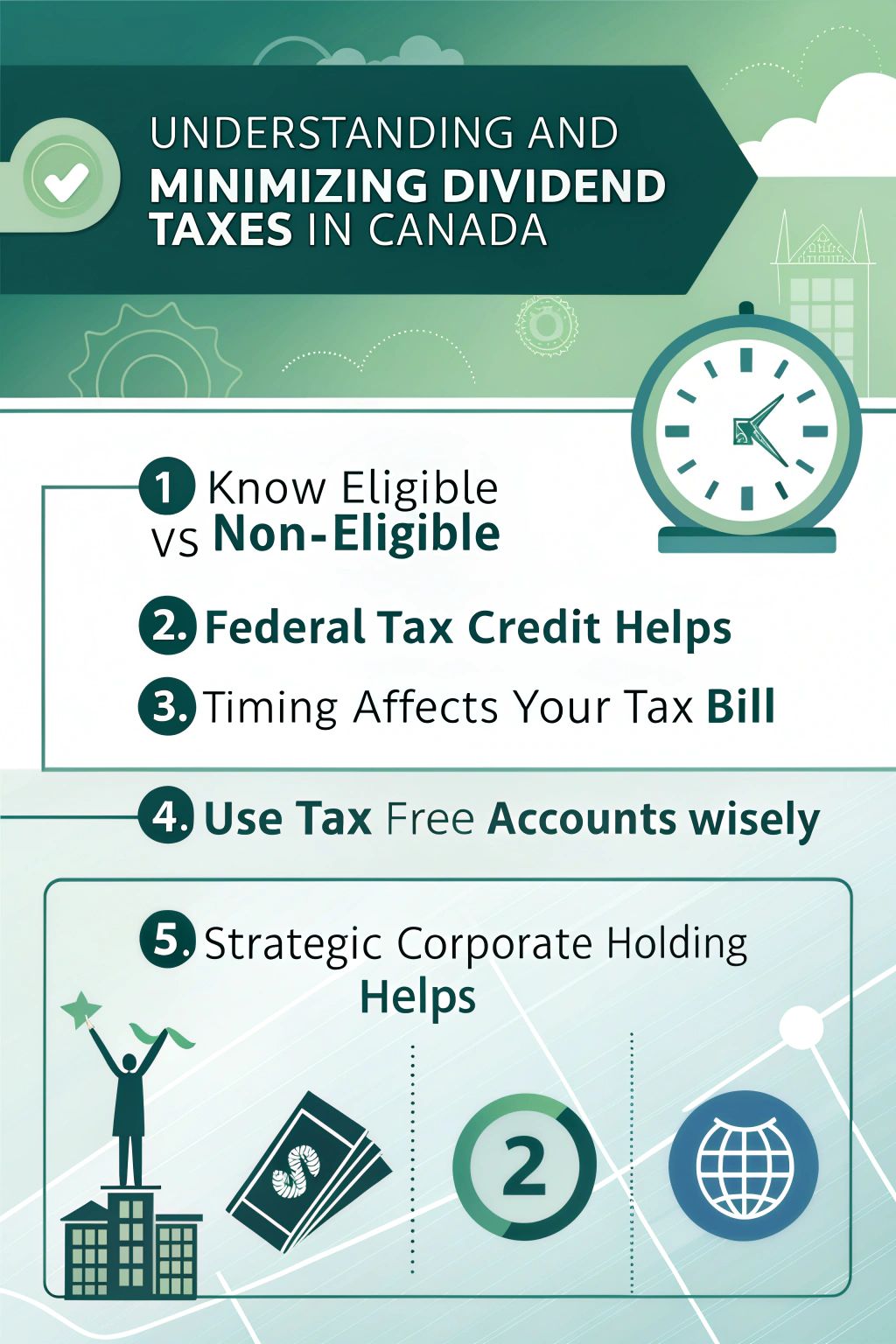
Key Takeaways
- Know the Difference: Understand the difference between eligible and non-eligible dividends. Eligible ones are taxed at lower rates because companies have already paid high taxes on their earnings 12.
- Use Tax Credits: The Federal Dividend Tax Credit helps reduce double taxation. For 2023, it’s 15.0198% for eligible dividends and 9.0301% for non-eligible ones 67.
- Timing Matters: Timing your dividend receipts can save you money. Receiving dividends at different times in a year could change your tax bill 12.
- Tax-Free Accounts Help: Using accounts like TFSAs or RRSPs can help minimise taxes on dividends. These accounts offer tax-free growth and withdrawals (TFSA) or deferred taxes (RRSP) 11.
- Corporate Strategies Work: Companies can use holding companies to manage profits better and cut costs through methods like dividend sprinkling while following strict rules 2021.
Overview of Dividend Taxation in Canada
Dividend taxation in Canada can seem tricky but understanding the basics makes it easier. Let’s dive into some key concepts that will help clear up this topic….
Definition of Taxable Dividends
Taxable dividends are payments you get from shares. These must be added to your income for tax purposes. Both individuals and companies need to include these in their taxable income. 1
These dividends can be either eligible or non-eligible. The type affects how much tax you owe. Eligible ones often come with lower taxes, while non-eligible ones usually have higher rates. 2
Knowing the difference can save you money on taxes.
Eligible vs. Non-eligible Dividends
Eligible dividends are a bit special. They come from companies that have already paid high taxes on their profits. Because of this, eligible dividends get taxed at lower personal tax rates. 3 This means less money goes to taxes and more stays in your pocket.
Non-eligible dividends don’t get the same break. These come from firms that did not pay as much tax yet on their income. As a result, non-eligible dividends are taxed at higher personal rates.
Keep an eye out—only taxable dividends after 2005 fall under these categories… Make sure you know which type you’re getting!
Understanding the Dividend Gross-Up
Gross-Up increases the dividend amount for tax purposes. This makes sure dividends are taxed similarly to regular income….
Concept of Gross-Up
Gross-up increases the amount of dividends for tax purposes. This helps stop double taxation on those dividends. 4 For eligible dividends, the gross-up rate is 38%. For non-eligible dividends, it is 15%.
Understanding how gross-up works can save you money.
Imagine you get $100 in eligible dividends. The government will increase this to $138 when calculating your tax. Non-eligible $100 dividend would become $115. This makes sure that taxes paid by companies are considered in personal income taxes too.
Calculating Gross-Up for Different Types of Dividends
Eligible dividends are grossed-up by 138%. If you get $100 in eligible dividends, it becomes $238 for tax purposes. 5 Non-eligible dividends are grossed-up by 115%. So, a $100 non-eligible dividend turns into $215.
This gross-up means more income to report but leads to bigger credits later. 5 Next, we will dive into how the Federal Dividend Tax Credit works….
The Federal Dividend Tax Credit
You can reduce your tax bill with the federal dividend tax credit. Learn how it works and how to calculate it….
Purpose of the Dividend Tax Credit
The Dividend Tax Credit (DTC) in Canada helps reduce the taxes you owe on dividend income. This tax credit stops double taxation. Dividends come from company profits, which already face tax at the corporate level.
The DTC makes sure you do not get taxed twice. 6
Eligible dividends receive a higher credit rate than non-eligible ones. This means less tax for you if your dividends are eligible. 6
The Dividend Tax Credit is key to fair taxation in Canada.
This system encourages investment by reducing your overall tax burden.
How to Calculate the Federal Dividend Tax Credit
First, find your total dividends. Let’s say you have $200 in eligible dividends. For 2023, multiply this by the federal dividend tax credit rate of 15.0198%. This gives you a credit of $30.04. 7
For non-eligible dividends, use the rate of 9.0301%. If you have $200 in these dividends, your credit is $18.06. Subtract these credits from your taxes owed… it helps lower your overall tax bill! 6
Provincial and Territorial Dividend Tax Credits
Different provinces in Canada have their own tax credits for dividends. These credits can vary, so it’s important to know what applies to you….
Variations Across Provinces
Provincial and territorial tax rates vary. Each region has its own local tax laws. This means dividend taxes can differ from one province to another. For example, Alberta might offer a higher tax credit than Ontario. 8
“Tax differences can impact your net income,” says John Doe, a financial expert. Newcomers may face limits on claiming certain credits. Emigrants also have different rules to follow.
Always check the specific rules in your area to avoid surprises when filing taxes. 9
Completing Form 428 for Provincial Credits
Form 428 helps you claim provincial and territorial dividend tax credits. This form is crucial if you’re seeking extra tax relief on dividends. Reductions in federal non-refundable claims need matching reductions in provincial claims. 8
First, get a copy of Form 428 from the Canada Revenue Agency website. Fill out your income details and calculate your eligible credits. Make sure to align any federal adjustments with your province’s rules.
Double-check all numbers to avoid errors… accuracy ensures you get the right credit!
Tax Implications of Dividend Income
Dividend income can affect your personal tax rate. Corporations also face unique rules for dividend taxation….
Impact on Personal Income Tax
Dividend income affects personal tax in multiple ways. It adds to your taxable income, which can push you into a higher tax bracket. However, there is good news: dividend income gets taxed favourably due to the federal dividend tax credit. 10
The after-tax return impacts both your cash flow needs and long-term goals. For example, if you earn $1,000 in eligible dividends, the gross-up increases it on paper to $1,380. You then get a tax credit that reduces what you owe.
This system makes dividends more attractive for many Canadians… helping with those long-term financial plans!
Corporate Recipients of Dividends
Understanding how dividends affect personal income tax is crucial. But, it’s just as important for businesses… Now, let’s look into corporate recipients of dividends.
Corporations often receive dividends from other taxable Canadian corporations. They can deduct these dividends on their taxes. This results in what we call tax-free intercorporate dividends. 1 It’s an advantage for many companies! However, there are anti-avoidance rules to consider. These rules prevent misuse and ensure fairness in the system.
This deduction helps keep more money within the business community. By allowing firms to share profits without extra tax burdens, they encourage reinvestment and growth within Canada.
Minimising Dividend Taxation
You can lower the tax you pay on dividends with smart planning. Use special accounts and think about the timing to get the best results.
Utilising Tax-Advantaged Accounts
Using tax-advantaged accounts like a Tax-Free Savings Account (TFSA) can help minimise dividend taxation. Investments in a TFSA grow tax-free, allowing for tax-free withdrawals. This keeps more of your money.
Another option is the Registered Retirement Savings Plan (RRSP). You get immediate tax relief on contributions and defer taxes until you withdraw funds later, often at lower rates.
Holding interest-generating investments in these accounts offers better tax efficiency too. 11
Timing of Dividend Receipt
Using tax-advantaged accounts is smart… but timing your dividend receipt can also save you money. Dividends received at different times in the year can change your tax bill. For instance, if you get dividends early in the year, they might push you into a higher tax bracket. 12
Eligible dividends taxed at lower rates need to be timed well to minimise taxes. Companies use GRIP and LRIP to manage when to give out these dividends. Late filing of eligible dividend designations since 29 March 2012, influences outcomes based on timing.
The Canadian tax system integrates corporate and personal taxes—so the timing of when you get dividends is crucial for claiming a dividend tax credit too! 13
Choosing Between Reinvesting vs. Cash Dividends
Choosing between reinvesting dividends or taking cash can impact your taxes. If you reinvest dividends, you buy more shares of the mutual fund or stock. These dividends are still taxable income, even though you do not receive cash in hand. 14
Taking cash dividends means getting a payment directly to your account. This is also taxable income. Both options have their benefits and drawbacks, but either way, those dividends will be taxed by Canada Revenue Agency (CRA).
Make sure to choose the option that fits your financial goals best!
Special Considerations for Corporate Investors
Corporate investors have unique tax rules for dividends. Businesses can benefit from different rates and pools, unlike individual taxpayers….
Tax Rates on Dividends Received by Corporations
Corporations in Canada pay different tax rates on dividends. For Canadian-Controlled Private Corporations (CCPCs), the rate can depend on whether the dividends are eligible or non-eligible.
Special provisions exist for deemed dividends under sections 84 and 84.1 that may qualify for eligible status. 15
CCPCs use a General Rate Income Pool (GRIP) to track eligible dividends. This helps determine which tax rate applies. The GRIP ensures that corporations only distribute amounts taxed at general corporate rates as eligible dividends…
making it easier to apply lower personal income taxes on those payments. Next up: Adjustment to General Rate Income Pool (GRIP) and Low Rate Income Pool (LRIP).
Adjustment to General Rate Income Pool (GRIP) and Low Rate Income Pool (LRIP)
A corporation’s GRIP tracks its income taxed at the general corporate rate. 16 This helps decide if it can pay eligible dividends. If a company’s eligible dividends exceed its GRIP, it faces a penalty—known as an Excessive Eligible Dividend Designation (EEDD).
On the other hand, the LRIP records income taxed at low rates. Corporations must manage both pools well to avoid extra taxes and penalties. Proper adjustment is key for tax planning and saving money in Canada.
Dividends from Foreign Corporations
Receiving dividends from foreign companies can be tricky. Different rules apply, and double taxation can become an issue….
Tax Treatment of Foreign Dividends
Dividends from foreign corporations face Canadian taxes. These are subject to withholding tax. 17 Canada also taxes income from overseas investments. Tax treaties can impact this taxation.
Non-residents in Canada who get dividends pay a withholding tax too. The Income Tax Act permits this rule for non-residents with Canadian businesses or investments.
Impact of Tax Treaties on Dividend Income
Tax treaties can lower the taxes on dividends from foreign companies. For example, the Canada-North American Tax Convention cuts dividend withholding tax rates to 5% or 15%. 18 This helps Canadians keep more of their money.
Non-residents may get refunds on withheld taxes. They need to file a non-resident income tax return. 18 These treaties make cross-border investing simpler and less costly for Canadians!
Common Misconceptions About Dividend Taxation
Many people misunderstand how the gross-up and tax credit system works. There are also common errors about what makes a dividend eligible or non-eligible….
Misunderstanding the Gross-Up and Tax Credit System
Misunderstanding the gross-up and tax credit system can lead to paying more taxes. Gross-up means increasing the value of dividends for tax purposes. Eligible dividends are grossed-up by 138%, while non-eligible ones are grossed-up by 115%. 7
After the gross-up, you get a federal tax credit. This helps lower your taxes owed. For eligible dividends, this credit is 15.0198%. For non-eligible ones, it is 9.0301%. Knowing these rates can help you understand how much tax you’ll really pay on your dividend income. 7
Confusions Regarding Eligible and Non-eligible Dividends
Many people mix up eligible and non-eligible dividends. Eligible dividends get better tax treatment and bigger tax credits. Non-eligible dividends do not. 19
Non-eligible dividends are grossed up by 15%. This means Canada adds 15% to the dividend amount before taxing it. Eligible dividends are grossed up by 38%. This helps reduce overall taxes with larger credits.
Understanding these differences is key for planning your investments and taxes.
Advanced Strategies for Dividend Tax Planning
Consider using a corporate structure to optimise your dividend taxes. Explore holding companies to see if they can minimise your tax burden further….
Role of Corporate Structure and Dividend Sprinkling
Proper corporate structure can help reduce dividend taxes. Companies can use holding companies to manage profits and cut tax costs. This method allows firms to reinvest earnings or pass them on as dividends when it is more tax-efficient. 20
Dividend sprinkling involves spreading income among family members. It uses each person’s lower tax bracket, which decreases the total tax paid. But be aware—Canada’s Income Tax Act has strict rules against this practice if not done correctly.
Utilising Holding Companies for Tax Minimisation
Using a holding company can cut your tax bill. You can transfer dividends to a holding company without paying taxes right away. 21 This move helps with cash flow and keeps more money in the business.
A key benefit is the Refundable Dividend Tax on Hand (RDTOH). With RDTOH, you get some of that tax back when you pay dividends from the holding company to shareholders. 21 This method saves money and boosts growth.
FAQs on Dividend Taxes in Canada
Dividend taxes in Canada can confuse many people. Here, we answer popular questions to simplify things.
Popular Questions and Expert Answers
Can I reduce tax on my dividends in Canada? Yes, use tax-advantaged accounts like TFSAs. Time your dividend receipt for lower-tax years. Think about reinvesting dividends to delay taxes.
Do stock dividends get taxed the same as cash? Stock dividends are taxed based on their fair market value at transfer time. 1 Same goes for dividends-in-kind. Both types hold similar rules to cash ones.
What should shareholders know when CCPCs pay eligible dividends?
Shareholders must receive written notice from CCPCs about these eligible payments. Public corporations can declare these at payment time without prior notice.
Tax Relief Programs in Canada
Tax relief programs in Canada help reduce the tax you owe. The Dividend Tax Credit is a big part of this. It cuts down how much tax you pay on eligible dividends, which are taxed at lower rates. 6
Using TurboTax can make it easier to report dividends and claim credits. There are other programs too, like credits for small businesses and personal income tax reductions. These resources make sure taxpayers get every break they deserve. 10
Conclusion
Understanding dividend taxes in Canada can save you money. By knowing the rules, you use credits and deductions wisely. Look at your timing and account choices for dividends. Plan well to reduce tax hits.
Always stay informed for the best outcomes.
FAQs
1. What are dividend taxes in Canada?
Dividend taxes in Canada are the tax amounts you pay on income earned from dividends, which are payments made by a company to its shareholders.
2. How can I minimise my dividend taxes?
You can minimise your dividend taxes by using tax credits, investing in tax-efficient accounts like TFSAs or RRSPs, and understanding different types of dividends.
3. Are all dividends taxed the same way?
No, eligible dividends and non-eligible dividends have different tax rates. Eligible ones usually come with higher tax credits.
4. Can I get any relief from paying high dividend taxes?
Yes, you may qualify for federal and provincial dividend tax credits that reduce how much you owe on your taxable income.
References
- ^ https://www.canada.ca/en/revenue-agency/services/tax/technical-information/income-tax/income-tax-folios-index/series-3-property-investments-savings-plans/series-3-property-investments-savings-plan-folio-2-dividends/income-tax-folio-s3-f2-c2-taxable-dividends-corporations-resident-canada.html
- ^ https://www.tsinetwork.ca/daily-advice/dividend-stocks/how-are-dividends-taxed-the-canadian-dividend-tax-credit/
- ^ https://www.taxtron.ca/blog/Eligible_vs_Non-Eligible_Dividends_What%E2%80%99s_the_Difference
- ^ https://tax.osgoode.yorku.ca/2020/09/deriving-and-understanding-dividend-gross-up-rates/
- ^ https://globallawexperts.com/dividend-gross-up-and-dividend-tax-credits-a-toronto-tax-lawyer-analysis-david-j-rotfleisch/
- ^ https://accountor.ca/blog/taxation/what-is-the-dividend-tax-credit-canada.html
- ^ https://www.investopedia.com/terms/d/dividendtaxcredit.asp
- ^ https://www.canada.ca/en/revenue-agency/services/tax/individuals/topics/about-your-tax-return/tax-return/completing-a-tax-return/provincial-territorial-tax-credits-individuals.html (2024-01-23)
- ^ https://www.fraserinstitute.org/sites/default/files/marginal-effective-tax-rates-across-provinces.pdf
- ^ https://www.rbcgam.com/en/ca/learn-plan/investment-basics/understanding-taxes-and-your-investments/detail
- ^ https://turbotax.intuit.ca/tips/tax-efficient-investing-a-beginners-guide-to-taxes-and-your-investments-14440?srsltid=AfmBOooNjnbN3BSMS7oMK0thvP_OvCmg7MOUK8hQW8nz6jAGESjl17VH (2023-07-17)
- ^ https://www.oecd.org/content/dam/oecd/en/publications/reports/2024/10/tax-arbitrage-through-closely-held-businesses_24b18f04/24b4ed4d-en.pdf
- ^ https://publications.gc.ca/collections/Collection/F21-4-96-7E.pdf
- ^ https://www.manulifeim.com/retail/ca/en/viewpoints/tax-planning/taxation-of-Investments-101
- ^ https://www.manulifeim.com/retail/ca/en/viewpoints/tax-planning/taxation-of-investment-income-within-a-corporation (2023-06-28)
- ^ https://ca.practicallaw.thomsonreuters.com/w-004-8805?transitionType=Default&contextData=(sc.Default)
- ^ https://digitalcommons.osgoode.yorku.ca/cgi/viewcontent.cgi?article=1051&context=reports
- ^ https://www.dentons.com/en/services-and-solutions/global-tax-guide-to-doing-business-in/canada
- ^ https://kssp.ca/whats-the-difference-between-eligible-and-non-eligible-dividends/
- ^ https://www.canada.ca/content/dam/fin/migration/n17/data/tppc-pfsp-eng.pdf
- ^ https://thinkaccounting.ca/blog/holding-company-strategy/ (2024-01-15)


