
Navigating Tax Laws for Smart Investments
Many people find tax laws for investments confusing. Did you know that in Canada, 50% of your capital gains are taxed as income? This article will help you understand these rules and offer smart strategies to lower taxes on your investments.
Ready to learn more? 2
Key Takeaways
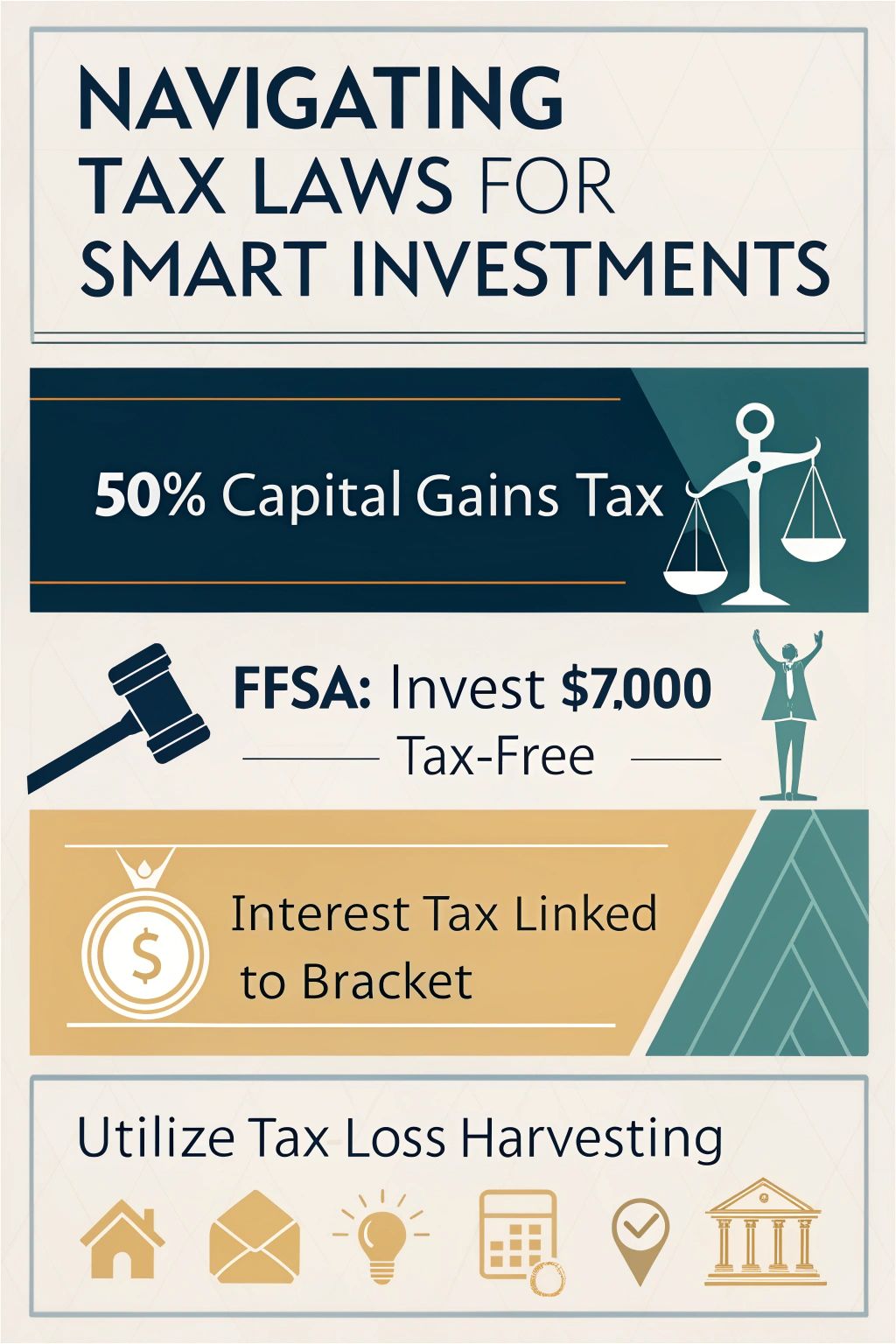
- Half of capital gains in Canada are taxed. From June 25, 2024, gains over $250,000 face a higher tax rate of 66.67%.
- Interest income is fully taxed based on your federal tax bracket. Dividends have a different tax rate and can be reduced with registered accounts.
- Use Tax-Free Savings Accounts (TFSA) to invest up to $7,000 annually without paying taxes on withdrawals.
- Tax-loss harvesting helps reduce your taxable capital gains by selling losing stocks and reinvesting smartly.
- Always stay updated with changes in tax laws and consult a tax expert for personalised advice.
Overview of Tax Laws Affecting Investments
Tax laws in Canada can be complex, especially for investments. Knowing the rules helps you make smarter choices and save money.
Capital Gains Tax
Capital gains tax in Canada applies when your investment’s value goes up. For example, if you bought stocks for $50,000 and sold them for $300,000 in 2024, you made a gain of $250,000.
Half of this gain is taxable. 1
As of June 25, 2024, new rules apply: The first $250,000 in gains are taxed at 50%, but anything above that is taxed at 66.67%. So if your gain was $300,000 total—$158,335 would be taxable income.
Corporations and trusts pay the higher rate (66.67%) on all their capital gains without any thresholds. 2
The Canadian Revenue Agency lets you offset current year gains with capital losses or carry back three years—or forward indefinitely.
Tax on Interest and Dividends
Interest income is fully taxed. This includes interest from savings accounts and bonds. The amount you pay depends on your federal tax bracket for 2024. You may be taxed at rates from 15% up to 33%. 3
Dividends come from public companies. They are paid quarterly, semi-annually, or annually. Dividends have a different tax rate than interest income. Using registered accounts can help reduce your tax burden on both dividends and interest income. 4
Strategies to Optimise Tax Outcomes for Investments
Understand how different accounts can benefit you. Employ smart techniques to reduce the taxes you pay on your investments….
Utilising Tax-Free Savings Accounts
Use Tax-Free Savings Accounts (TFSA) to boost your tax-free investment accounts and maximise benefits. In 2024, you can contribute up to $7,000. 6 Since 2009, the cumulative limit stands at $95,000. 5
Withdrawals from a TFSA are tax-free. 5 This means all growth in your account stays with you without extra taxes. Unlike RRSPs or RESPs where contributions have different rules, TFSAs give more freedom.
So it’s perfect for long-term savings or financial planning for any goal – like retirement or education.
Engaging in Tax-Loss Harvesting
Tax-loss harvesting helps you save on taxes. Sell losing stocks to offset your capital gains. This reduces your tax liabilities. 7
“J.P. Morgan uses smart tech for this,” said a financial expert. Reinvest in similar but different securities to follow the wash sale rules.
For personalised services, J.P. Morgan needs at least $250,000 investment. 7 Options include U.S. Large Cap Index and U.S. All Cap Index funds—perfect for reducing taxes while investing wisely!
Conclusion
Understanding tax laws helps you make smart investment choices. Stay informed about the latest changes to maximise your gains. Use strategies to lower taxes and protect your wealth.
Always consider getting help from a tax expert for personal advice. Happy investing!
FAQs
1. What are the key tax laws for smart investments?
Understanding capital gains tax, income tax on dividends, and inheritance tax is essential for making informed investment decisions.
2. How can I reduce my taxes on investments?
Utilise ISAs (Individual Savings Accounts), invest in pensions, and consider holding assets long-term to benefit from lower capital gains rates.
3. Are there any common myths about investment taxes?
Yes, many believe all investment profits are heavily taxed. However, various allowances and reliefs exist that can significantly reduce your taxable amount.
4. Can data help me make better investment choices regarding taxes?
Absolutely! Analysing historical data and current trends can guide you in choosing tax-efficient investments… helping you maximise returns while minimising liabilities.
References
- ^ https://www.gov.uk/capital-gains-tax
- ^ https://www.investopedia.com/terms/c/capital_gains_tax.asp
- ^ https://www.gov.uk/government/collections/tax-on-savings-and-investments-detailed-information
- ^ https://www.investopedia.com/articles/investing/072313/investment-tax-basics-all-investors.asp
- ^ https://www.investec.com/en_za/focus/money/five-things-to-consider-for-tax-free-savings.html (2023-01-27)
- ^ https://heightenaccountants.co.uk/tax-planning/
- ^ https://privatebank.jpmorgan.com/nam/en/services/investing/managed-portfolio-strategies/tax-smart-strategies


