
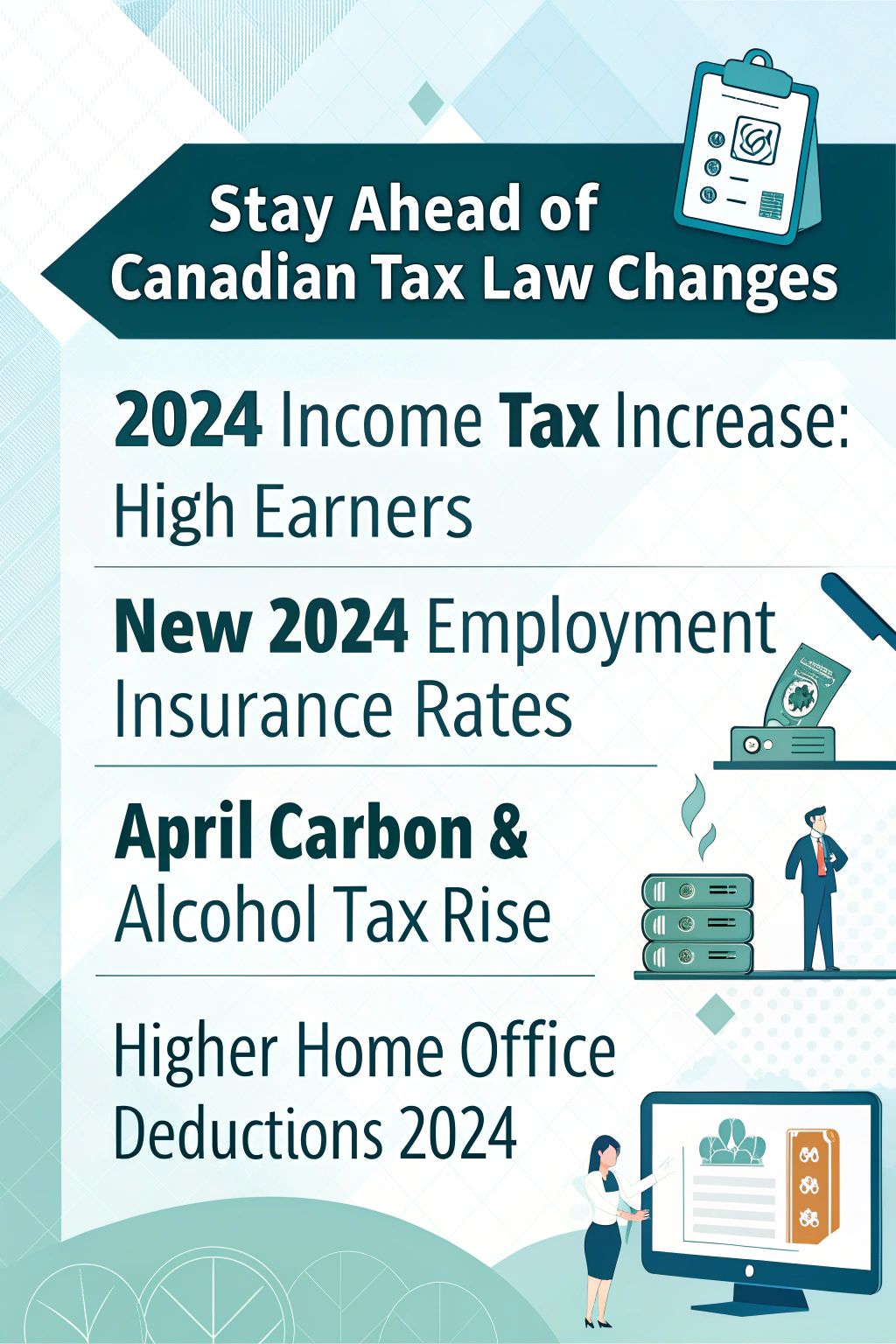
Stay Ahead of Canadian Tax Law Changes
Are you overwhelmed by tax law changes in Canada? Many people are. The 2024 rules bring new updates that can impact your wallet. 1 This article will help you stay ahead and make sense of it all.
Keep reading to learn more!
Key Takeaways
- Income Tax Changes: In 2024, Canada will raise taxes on high-income earners. This aims to make the system fairer. It plans to collect CAD 21.9 billion over five years.
- Employment Insurance Updates: Workers and employers will see new rates in 2024. Quebec has lower rates than other provinces.
- Carbon and Alcohol Taxes: Carbon tax rises to $80 per tonne for gasoline from April 1st, raising petrol prices by about 3 cents a litre. New alcohol excise duty rates also take effect on the same date.
- Home Office Deductions: From January 2024, you can claim more home office expenses like internet fees. The flat rate is now $2 per day for up to 200 days.
- Crypto Assets Reporting: New rules will make sure people correctly report earnings from cryptocurrency following OECD/G20 guidelines for consistency and fairness.
Overview of Canadian Tax Law Changes for 2024
Big changes are coming to Canadian tax laws in 2024. You’ll want to be prepared… and we’ve got the key details you need.
Federal income-based taxes
Federal income-based taxes will see some changes in 2024. The new Budget proposes higher taxes on high-income earners. This reform aims to make the tax system fairer and more efficient for all Canadians. 1
These changes are expected to bring CAD 21.9 billion over five years. “This revenue will help build homes and create jobs,” says a government official. 1
Next is Employment Insurance updates…
Employment Insurance updates
Employment Insurance (EI) rates change in 2024. Workers will pay $1.66 per $100 of insurable earnings and employers will pay $2.32. 2 Quebec residents have lower rates: workers pay $1.32, and employers pay $1.85.
Maximum Insurable Earnings rise to $63,200 in 2024 from $61,500 in 2023. 2 Seasonal workers can get up to 45 weeks of benefits until October 2024. Sickness benefits increase from 15 to 26 weeks since December 18, 2022.
Self-employed workers must earn at least $8,492 to qualify for special benefits.
Next: Modifications in carbon taxes… 3
Modifications in carbon taxes
With changes to Employment Insurance in mind, let’s dive into carbon taxes. The Fuel Charge will increase to $80 per tonne for petrol on 1 April 2024. 4 This hike will raise petrol prices by about 3 pence a litre.
About 90% of the federal fuel charge revenue goes back to individuals through the Canada Carbon Rebate. 4 A new refundable tax credit will help small- and medium-sized businesses cover costs.
Farmers also get relief with a special tax credit for fuel charges they pay… making sure farming stays viable and green!
Adjustments to alcohol taxes
– Modifications in carbon taxes
As these new changes unfold, let’s move to another important area…
– Adjustments to alcohol taxes
Starting April 1, 2024, excise duty rates on spirits and wine will change. The new rate for spirits with more than 7% alcohol will be $13.569 per litre. For those under or equal to 7%, the rate is set at $0.344 per litre.
Wine also sees new rates: up to 1.2% alcohol keeps a low tax of $0.022 per litre… Between 1.2% and 7%, it rises to $0.344 per litre… More than 7% bumps it up further to $0.716 per litre! Bill C-69 introduces a cap—any adjustments can’t exceed more than two percent each year for the next two years.
Non-alcoholic options stay exempt from duties if they stick below or at .5% ABV. 5
Digital services tax implementation
Canada introduced a Digital Services Tax (DST) on 28 June 2024. It started from Bill C-59, enacted on 20 June 2024. The DST targets businesses with huge digital revenues. Companies must have global revenues of €750,000,000 and Canadian in-scope revenue of CA$20,000,000 to comply.
The tax rate is set at 3%. What’s interesting…it applies retroactively starting from January 1, 2022! This change ensures large tech companies pay their fair share for using our market.
This new regulation is just one part of the updates coming for next year’s tax season.
### Key Developments in Tax Regulations
Key Developments in Tax Regulations
Canadian tax laws are changing for 2024. You need to know the key updates to avoid surprises….
Higher interest rates for late tax payments
Starting January 2024, the CRA will raise interest rates on overdue taxes to 10%, up from 9%. 7 This rate is tied to the Government of Canada three-month Treasury bill yields plus four percentage points.
Daily compounding interest will apply to late tax payments. “Higher rates mean more risks for taxpayers,” said John Smith, a financial adviser. Not only do you face increased costs, but additional penalties can also be imposed.
Higher rates mean more risks for taxpayers, said John Smith, a financial adviser.
Stay aware and plan ahead… let’s look at expanded home office expenses deductions next!
Expanded home office expenses deductions
The CRA has expanded the list of expenses you can deduct. Now, you can claim reasonable home internet access fees. 8 Employers can also reimburse up to $500 tax-free for home office equipment.
Anything over that becomes taxable income.
The Temporary Flat Rate Method lets you claim $2 per day for up to 200 days—making it a total of $400. 8 This makes claiming easier and faster, especially if you work from home often.
These changes help more Canadians save on their taxes!
Wider trust reporting rules
New trust rules in Canada start after December 30, 2023. Trusts must share detailed information. They need to tell about beneficiaries, settlors, and trustees.
The first deadline is March 30, 2024. Penalties for non-compliance are big. These rules apply to Canadian trusts and some foreign ones with Canadian connections—like assets or beneficiaries in Canada. 9
Trusts that exist for less than three months or hold under CA$50,000 cash get exemptions. It’s vital to know these new obligations and avoid penalties by meeting the deadlines!
Modernising Canada’s Tax System
Canada is taking big steps to update its tax system. These changes will make filing easier and improve how the tax office helps you… Stay tuned for more!
Automatic tax filing for low-income Canadians
Automatic tax filing helps low-income Canadians. The CRA will send SimpleFile invitation letters in July 2024 as part of a pilot programme. 10 Three services are available: SimpleFile by Phone, SimpleFile Digital, and SimpleFile by Paper.
Eligibility requires an income below a set threshold and specific income sources. By 2025, the number of eligible Canadians for SimpleFile by Phone will grow from 700,000 to 2 million.
Users can file by answering questions over the phone with this service.
Reducing CRA call centre wait times…
Reducing CRA call centre wait times
The CRA is making big changes to improve their call centres. They are using modern technology to cut down on wait times. 12 More agents have been hired, which means faster service for everyone.
The CRA has also extended call centre hours from 8 a.m. to 8 p.m., giving people more time to get help.
A new feedback system lets callers rate the service they get right away. This helps the CRA make improvements fast. 12 Updated service standards aim for better transparency and consistent delivery of support…
driving towards a single sign-in portal for government services next!
A single sign-in portal for government services
Reducing CRA call centre wait times is a big step. But there’s more… The government plans to make things easier with a single sign-in portal for all services. From 2024, Budget proposes $25.1 million over five years to set this up. 1
Imagine not needing different logins! This new online portal will let you access many services with just one password. It means faster and smoother user authentication, more secure sign-ins, and less hassle overall.
You get an efficient user experience while streamlining your access to integrated government services.
Enhancing Tax Fairness
Fair taxation helps everyone, including big companies and entrepreneurs… Find out how new rules make taxes fairer for all.
Ensuring global and digital corporations pay their fair share
Big digital companies need to pay their fair share. Pillar One will ensure that the largest and most profitable corporations do this. This includes big names like Google and Facebook. 1
Canada aims for fairness in its tax laws. Multinational corporations should not avoid taxes by shifting profits across borders. These changes help level the playing field for smaller businesses, too…
Next, let’s explore a tax break for entrepreneurs!
A tax break for entrepreneurs
Entrepreneurs in Canada can expect exciting changes. The Lifetime Capital Gains Exemption will rise to $1.25 million for small business shares and some property sales. This means more tax relief for business owners. 13
A new Canadian Entrepreneurs’ Incentive will offer a one-third inclusion rate on up to $2 million in eligible capital gains. This helps reduce the tax burden on gains up to $6.25 million, supporting small business owners and startups…
### Expanding tax transparency to crypto-assets
Expanding tax transparency to crypto-assets
Canada wants more clarity in crypto-asset taxes. The new rules will make sure people report their cryptocurrency earnings correctly. This helps create a fair tax system. 1
The OECD/G20 Crypto-Asset Reporting Framework (CARF) guides these changes. CARF ensures global consistency, making it easier to track and report digital currencies. 14 These updates help Canada stay on top of modern assets…
leading us to understand the importance of capital gains tax next!
Understanding Capital Gains Tax
The new capital gains inclusion rate is increasing from 50% to 66.67%. 15 This change starts on June 25, 2024. 15 It affects net capital gains over $250,000 a year for people and all net gains for companies and most trusts.
Tax-free savings accounts and pension plans do not face capital gains tax. People can explore tax reduction strategies like holding investments longer or using the lifetime capital gains exemption.
Knowing these rules helps in smart financial planning!
Preparing for Tax Season 2024
Tax season 2024 has some new twists. Get ready for changes that impact both individuals and businesses….
What’s new for individuals
In 2024, there are several changes for individuals in Canada. One key update is that you can now claim more home office expenses. This helps people working from home get bigger tax deductions. 16
Another important change involves adjustments to benefits and credits. Families might see new amounts, giving a bit of relief during the tax season… Next up, let’s explore what’s new for businesses!
What’s new for businesses
Businesses must now file six or more information returns electronically. This rule starts on January 1, 2024. Filing these returns on paper will lead to penalties.
All GST/HST registrants also need to file their returns electronically in 2024. Employers issuing T4 and T4A forms have new Canadian Dental Care Plan (CDCP) reporting requirements starting with the 2023 tax year.
Trusts must include beneficial ownership info in their annual T3 income tax return for any tax years ending after December 30, 2023.
The CRA has defined Province of Employment (POE) for remote work agreements. This new policy starts on January 1, 2024….
– What’s new for trusts
What’s new for trusts
New rules now require most personal trusts to file an annual T3 income tax return. This starts from taxation years ending after December 30, 2023. 18 Bare trusts do not need to file the T3 returns yet…
but only until December 31, 2024.
Trusts must share detailed beneficial ownership info on a new T3 Schedule 15 form. There are some exceptions though. Trusts that exist for less than three months or hold less than $50,000 in assets may avoid filing under specific conditions. 18 Non-compliance can be costly! Penalties could reach up to $2,500 or five percent of the trust’s highest fair market value.
Conclusion
Stay ahead of Canadian tax law changes to keep your finances in top shape. Stay informed and plan wisely. These updates can help you save money and avoid surprises. Keep learning about new rules so you stay compliant and smart with your taxes.
FAQs
1. What should I know about recent Canadian tax law changes?
Recent changes in Canadian tax laws can affect how much you owe and what deductions you can claim. It’s vital to stay updated to avoid penalties.
2. How can I stay informed on these changes?
You can subscribe to newsletters from trusted financial websites, consult with a tax advisor, or follow updates from the Canada Revenue Agency (CRA).
3. Are there common misconceptions about Canadian taxes?
Yes, many people think that all income is taxed at the same rate—this isn’t true. Tax rates vary based on income brackets and types of earnings.
4. What practical steps can I take to adapt to new tax laws?
Review your finances regularly, keep detailed records of expenses and earnings, and seek professional advice if needed… These actions help ensure you’re compliant and optimised for any new rules.
References
- ^ https://budget.canada.ca/2024/report-rapport/chap8-en.html (2024-04-16)
- ^ https://www.canada.ca/en/employment-social-development/programs/ei/ei-list/reports/premium/rates2024.html
- ^ https://knowledge.dlapiper.com/dlapiperknowledge/globalemploymentlatestdevelopments/2024/unpacking-proposed-changes-to-canadas-federal-employment-laws
- ^ https://www.canada.ca/en/environment-climate-change/services/climate-change/pricing-pollution-how-it-will-work/putting-price-on-carbon-pollution.html
- ^ https://www.canada.ca/en/revenue-agency/services/forms-publications/publications/edn90/adjusted-rates-of-excise-duty-on-spirits-and-wine-effective-april-1-2024.html
- ^ https://globaltaxnews.ey.com/news/2024-1339-canada-sets-entry-into-force-date-for-digital-services-tax-act (2024-07-10)
- ^ https://www.investmentexecutive.com/news/from-the-regulators/cras-10-interest-rate-on-overdue-tax-raises-risks/ (2023-11-13)
- ^ https://www.doanegrantthornton.ca/insights/new-guidance-on-claiming-home-office-deductions-during-covid/
- ^ https://www.ey.com/en_gl/technical/tax-alerts/canada-s-new-trust-reporting-requirements-to-impact-many-foreign
- ^ https://www.canada.ca/en/revenue-agency/campaigns/offering-and-expanding-automatic-tax-filing-services.html (2024-07-23)
- ^ https://www.ctvnews.ca/business/as-canadians-miss-out-on-benefits-ottawa-promises-automatic-tax-filing-is-on-the-way-1.6335333 (2023-03-30)
- ^ https://www.canada.ca/en/revenue-agency/campaigns/serving-canadians-better-cra/improving-services-cra.html (2019-04-24)
- ^ https://www.canada.ca/en/department-finance/news/2024/06/government-of-canada-delivering-tax-fairness-for-every-generation.html (2024-06-10)
- ^ https://www.oecd.org/en/publications/bringing-tax-transparency-to-crypto-assets-an-update_b33c9aa1-en.html
- ^ https://www.cpacanada.ca/news/Analysis/capital-gains-deadline (2024-06-25)
- ^ https://www.canada.ca/en/services/taxes/income-tax/personal-income-tax/get-ready-taxes.html
- ^ https://www.canada.ca/en/revenue-agency/news/newsroom/tax-tips/tax-tips-2023/businesses-here-are-top-changes-this-year-will-affect-business-taxes-2024.html (2023-12-20)
- ^ https://www.mnp.ca/en/insights/directory/new-trust-reporting-rules-are-you-ready (2024-10-16)


